


According to the most recent data from the World Intellectual Property Organization (WIPO), Brazil ranks among the top five countries with the highest number of trademark applications. In 2024, the Brazilian Patent and Trademark Office (BPTO) received 444,037 trademark applications, representing an increase of 10.3% compared to the previous year , which had already been growing.
In 2023, the number of trademark applications in Brazil reached 441,310, and in 2022, it totaled 397,099 applications.
In a period of just over 5 years, Brazil rose from 10th to 5th place in the global ranking of countries with the highest number of trademark applications.
The projection for 2025 is that more than 500,000 trademark applications will be filed in Brazil, reflecting a remarkable growth trajectory.
While this surge in trademark filings demonstrates an increasing interest of both national and foreign companies in the Brazilian market, it simultaneously imposes a significant burden on the Brazilian Patent and Trademark Office (BPTO) in terms of examination workload.
About five years ago, the average timeframe for examining a trademark application in Brazil was around 10 months. However, in alignment with the guidelines of the National Industrial Property Strategy (ENPI), the BPTO has set a target to reduce the examination period to just one month, especially for cases without opposition.
This ambitious goal, however, would only be feasible with a substantial legislative reform, as the current Industrial Property Law (IP Law) imposes mandatory procedural deadlines (e.g., 60 days for opposition after publication, 60 days for payment of the final registration fees after approval, among others) that would make such a target impossible under the present framework.
To address this, Bill PL 2210/2022, currently under review in the Federal Senate and under the rapporteurship of Senator Dr. Hiran (PP), proposes significant changes to the administrative procedures for trademark registration in Brazil, aiming to streamline the process and enable the BPTO to achieve these ambitious timeframes.
However, the BPTO’s 2025 Action Plan, published in December 2024 , pointed out that, by November 2024, the average time for examining trademark applications without opposition had already reached 21 months, while applications with opposition were taking approximately 33 months to receive a decision. Please see the graph below for a visual representation of these timelines:
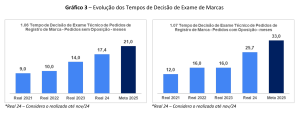
It is evident that the BPTO has not been able to efficiently meet the growing demand for trademark applications in recent years. The number of applications has exponentially exceeded the Office’s examination capacity, even considering the hiring of 40 new trademark examiners in 2024.
Additionally, the statistics show a 21.3% drop in the granting of trademark registrations, further highlighting a decline in the BPTO’s productivity.
Thus, there is an urgent need to seek a balance between the increasing administrative demand for trademark registrations and the Agency’s examination capacity. This would require investments in technology and personnel to make it possible to reduce examination deadlines.
It is true that the BPTO has been striving for a larger budget, training of examiners, and the adoption of initiatives aimed at improving productivity, particularly involving the application of Artificial Intelligence. However, the prognosis is that no significant improvement is expected in the short or medium term.
Moreover, the growing number of trademark applications also raises concerns about the saturation of the trademark system. It is becoming increasingly difficult to find available trademarks, which complicates the entry of new brands into the market and increases the likelihood of conflicts between rights.
Additionally, with the increase in the number of trademarks, the possibility of collisions between similar marks also rises, leading to a greater number of oppositions, nullity actions, and administrative and judicial litigation. This situation results in an escalation of disputes both before the BPTO and within the specialized courts.
On another front, the large volume of existing trademarks in Brazil raises concerns regarding the effectiveness of the trademark system, particularly in relation to trademarks that are not actively used in the marketplace and fail to fulfill their social function.
This situation reflects the phenomenon globally known as “deadwood”, referring to “idle” or “inactive” trademarks. The term “deadwood” describes trademarks that are registered but not effectively used, remaining in the system without serving their primary purpose of distinguishing goods or services in the market.
The presence of a significant amount of deadwood burdens the system, complicates clearance searches, and creates unnecessary barriers for new market entrants.
These trademarks are formally registered with the BPTO, but are not effectively used by their owners and may block the registration of similar trademarks by third parties who actually intend to use them in commerce.
The problem lies in the fact that Brazilian legislation does not require the mandatory use of a trademark or the periodic submission of declarations or evidence of use, as is the case in several other countries, such as the United States, Mexico, Argentina, among others.
Under the Brazilian Industrial Property Law, the only applicable mechanism is forfeiture (extinction due to non-use), which must be expressly requested by a third party. Forfeiture may occur if, after five years from the granting of the registration, the trademark has not been used or if use has been interrupted for more than five consecutive years. It can also be invoked if, within the same period, the trademark has been used with modifications that alter its original distinctive character, as stated in the registration certificate.
Thus, the current framework does not allow for automatic elimination of unused trademarks, which contributes to the accumulation of deadwood and creates significant challenges for the efficiency and functionality of the trademark system in Brazil.
Thus, in a scenario where more and more trademarks are registered without the obligation to prove use, the saturation and loss of efficiency of the trademark system becomes a major concern, and unfortunately, we do not foresee a solution in the near future.
In addition to the BPTO’s overload in the processing and examination of trademark applications and the deadwood phenomenon, we must also consider the BPTO’s initiatives aimed at the expansion of trademark protection.
In this regard, it is worth noting that, in September 2021, through Ordinance/INPI/PR No. 37, of September 13, 2021, the BPTO began allowing the registration of position marks.
This represents a significant expansion of the scope of protection in Brazil, aligning the country with international practices and opening new avenues for brand owners to secure exclusive rights over distinctive positions of signs applied to products or their packagin.
A position mark is one formed by the application of a sign in a singular and specific position of a given support, resulting in a distinctive set capable of identifying goods or services and distinguishing them from others identical, similar or similar, provided that the application of the sign in that position of the support can be dissociated from technical or functional effect.
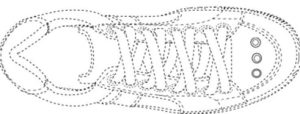
On May 30, 2023, the first registration (number 830621660) was granted for a position mark, for Osklen, described as “The sign consists of a sequence of three identical eyelets, where the middle eyelet is equidistant from the eyelets on its left and right sides. This trio of eyelets is intended for application on the upper part of a sneaker, specifically in the area between the toe and the tongue (the part typically covered by the laces). According to the images presented, the application of the sign occurs in a transverse position relative to the sides of the sneaker”:
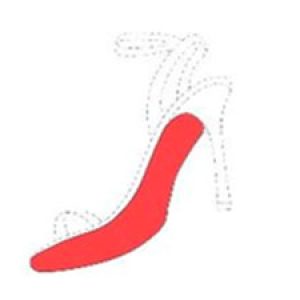
As of April 2024, there were 154 applications for the registration of position marks before the BPTO, with only one registration granted and 61 applications rejected. Among those rejected was the application for the registration of the famous red sole of Christian Louboutin as a position mark, a case that was subsequently judicialized. The Specialized Federal Court of Rio de Janeiro later upheld the action filed by Louboutin, recognizing the distinctiveness and notoriety of the red sole[3].
In addition, there has been significant progress in the protection of slogans and advertising expressions as trademarks. Since November 27, 2024, the BPTO has accepted the registration of trademarks that include slogans, based on a new interpretation of Article 124, item VII, of the Brazilian IP Law. This provision prohibits the registration of a trademark consisting of a “sign or expression used solely as a means of advertising”.
This marks a substantial shift in the BPTO’s approach. Until then, the BPTO rejected the vast majority of trademark applications containing advertising expressions, without properly analyzing whether the expression was being used as a distinctive sign rather than solely as advertising. The prior practice failed to recognize that original and creative slogans can indeed perform a distinctive function, identifying a specific product or service, as seen with famous examples like: “Just Do It”, “I’m Lovin’ It”, “Red Bull Gives You Wings”, “There are some things money can’t buy. For everything else, there’s MasterCard” among others.
On another front, in October 2024, the BPTO held a public consultation on the Normative and Trademark Guidelines regarding Acquired Distinctiveness, aiming to gather suggestions and feedback from society on the proposed regulation and examination guidelines for assessing distinctiveness acquired through use during trademark registrability examinations.
This is an extremely relevant development, as, until now, the BPTO has not analyzed acquired distinctiveness and has routinely rejected applications for trademarks composed of signs initially devoid of distinctiveness. Even when such signs had gained distinctiveness through use, trademark owners were often forced to seek recognition of secondary meaning through judicial proceedings.
Thus, once the BPTO publishes the amendment to the Trademark Manual, a sign lacking inherent distinctiveness may be registered as a trademark if it is proven that the sign has acquired distinctiveness through effective and continuous use in the market. It must be shown that the relevant consumer public recognizes the sign as capable of identifying the origin of the goods or services and distinguishing them from identical or similar goods or services offered by competitors.
The regulation is expected to be published soon and will represent a major advancement in Brazilian trademark practice, aligning it more closely with international principles and providing greater protection for brands that achieve distinctiveness through market presence.
There is also an indication that the BPTO is conducting studies aimed at the development of technical procedures for the examination of sound marks and olfactory marks, reinforcing the BPTO’s tendency to move toward the protection of non-traditional trademarks.
As we can see, the trademark landscape in Brazil is dynamic, presenting both significant challenges and great opportunities. On one hand, we face vertiginous growth in the number of registration applications and the resulting system overload; on the other hand, we are witnessing the evolution of trademark protection, with the recognition of new forms of trademarks and the modernization of BPTO procedures.
These developments, although complex, demonstrate that intellectual property in Brazil is undergoing a significant transformation, striving to align with best international practices and to respond to the increasing sophistication of the market.
It is certain that we will continue to face obstacles, whether related to reducing examination times, eliminating the deadwood, or expanding protection categories. However, the most important thing is to maintain a watchful eye, optimism, and a willingness to actively contribute to the continuous improvement of our trademark system.
[1] Available in: https://www.gov.br/inpi/pt-br/central-de-conteudo/estatisticas/arquivos/publicacoes/boletim-mensal-de-pi_resultados-de-dezembro-2024.pdf
[2] Available in: https://www.gov.br/inpi/pt-br/central-de-conteudo/noticias/inpi-divulga-seu-plano-de-acao-2025/PA2025_27.12.2024_v.final.pdf
[3] Case No. 5082257-22.2023.4.02.5101, 13th Federal Court of Rio de Janeiro.